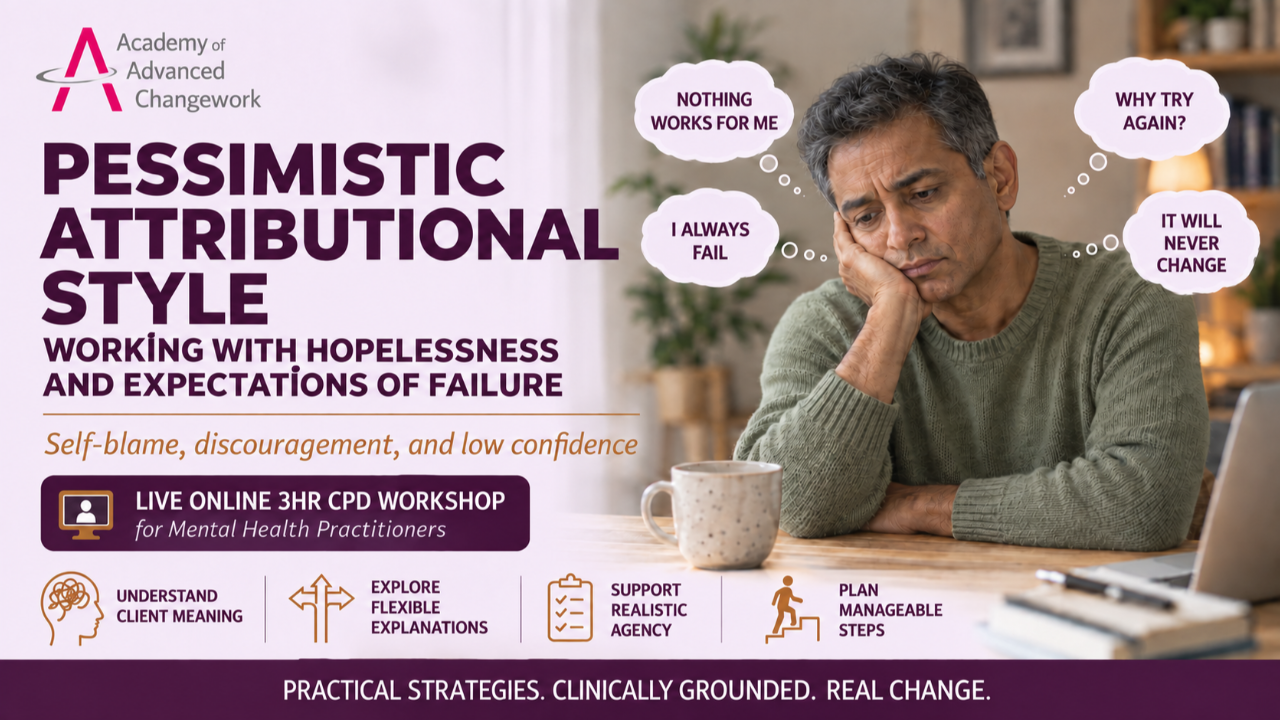
Pessimistic Attributional Style - Working with Hopelessness and Expectations of Failure
Live Online 3hr CPD Workshop for Mental Health Professionals
Course Overview
This 3-hour interactive training workshop supports compassionate mental health professionals to work more effectively with clients who appear discouraged, self-critical, resigned, or reluctant to try again. It introduces a psychologically informed framework for understanding pessimistic attributional style: the tendency to explain setbacks as personal, permanent, and affecting many areas of life.
Participants will explore how developmental experiences, repeated disappointment, and current maintaining factors can shape expectations of failure. The focus is practical, ethical, and clinically grounded — helping attendees understand the meaning clients attach to setbacks, distinguish pessimistic interpretations from genuine barriers, and support realistic hope and agency without pressure or premature reassurance.
What will this training give you?
A clearer understanding of how pessimistic explanations can influence confidence, motivation, and engagement
Insight into possible developmental origins, core beliefs, and maintaining factors
Practical language for exploring statements such as “Nothing works for me” and “I always fail”
Greater confidence validating disappointment while gently exploring more specific, flexible explanations
Tools you can apply immediately to co-create manageable experiments and review progress without increasing self-blame
Learning Objectives
- Evaluate pessimistic attributional style as a formulation framework, including its possible coping function and developmental influences
• Identify personal, permanent, and global explanations of setbacks, and distinguish them from realistic concerns and practical barriers.
• Demonstrate validating communication and meaning-focused questions before introducing alternative explanations.
• Apply collaborative setback review and behavioural experimentation to support realistic agency, evaluating outcomes alongside effort, symptoms, and available support.
Assessment / Evidence of Learning
Learning is evidenced through active participation in guided reflection activities, clinical discussion, and practical exercises during this live workshop. Supported skills practice provides opportunities to demonstrate the learning objectives.
Participants receive a certificate of attendance for 3 CPD hours.
Please note, to fulfill the learning outcomes, this course does require active participation and contribution in activities and exercises. Participants are expected to have their camera on, especially in breakout rooms.
If the above is not possible on the day, a certificate of attendance may not be awarded and participants will have the option to attend the training at a later date where available.
About the Presenter
Karen Bartle is a postgraduate in Health Psychology, Advanced Clinical Hypnotherapist, clinical supervisor, co-founder of the Academy of Advanced Changework, founder of HealthTalk Psychology, and co-author of The Advanced Hypnotherapist.
With 25+ years’ experience, Karen supports practitioners working with complex behavioural and relational patterns. She is known for translating psychological depth into practical, usable clinical skills.
Who is this course for?
This training is designed for compassionate mental health professionals who care deeply but feel stuck with a proportion of their clients who expect change to fail, interpret setbacks as personal inadequacy, or struggle to re-engage after disappointment.
It is especially suited to practitioners working with self-criticism, low confidence, repeated setbacks, chronic health challenges, or discouragement around change.
Places are limited to ensure an interactive, skills-focused learning experience.
Course Feedback
"I've really enjoyed your training, and how you present the topics. Very Professional, calm and insightful."
"I really enjoyed the workshop and have two coworkers attending your next one!"
"The training was rich in content and strategies, was also interactive which is always good. I enjoyed it and found it beneficial."
"Thankyou for such an amazing webinar. It was extremely helpful and informative."
“Thanks so much for the workshop. I really enjoyed it. I got a lot of great tips and skills to use”
"An interesting presenter and gentle presentation and that in itself taught me something about her values and how to be with clients. I was reminded of the care that is needed to assist vulnerable clients hoping for some changes."
“I really enjoyed learning more about this topic of creating a safe space for clients. It allowed me to reflect upon the clients I have worked with as a therapist, also as a client myself - working with therapists who were not safe, and who also broke rapport with me.”
"Thankyou, Karen. This session was excellent!"
“The quality of content, course organisation, course documents, and ability to sustain my interest were all great.”
“An interesting and thought-provoking session”
“The course developed my skills…and the quality of communications and explanation of what was expected were very good”
"Thank you for your authentic presentation, affirming discussions and inclusive time with this group. Beautiful values and ideas presented today and modelling of what a safe and genuinely person-centred therapist is like."
“Clients can feel gaslit that it was somehow their ‘fault’ things didn’t work with their therapist. Clients come to therapists for help, and the gravity of this shone through with this cpd.”
"I genuinely enjoyed the speaker and appreciated the material, thank you."
"Practical, relatable and immediately applicable. This training has transformed the way I work with clients who seem 'checked out'."
“Tutor approachability was very good and I felt valued during the workshop”
“I enjoyed learning about and reflecting on all the reasons why clients are ‘resistant’ (which I see now can be a brilliant subconscious protection mechanism) …and how I cannot control all of these reasons, but I can remember the importance of creating a safeherapy space.“
"I learned the importance of your own regulation and the ability to sit in the stillness and silence."
"I feel I know how to recognise this now and that I .have so many things I can say (or not say!?)"
"I learned the importance of helping them stay safe."
"I feel I know how to recognise this now and that I have so many things I can say (or not say!?)"
"I learned to remember to reaffirm autonomy"
"I recognise that silence is not always a bad thing"
"I'll remember to not to worry if we go slow & the client stops talking."
"Love the idea of lowering urgency in a session to rebuild trust."
"Not to be in a rush to ease their discomfort but always make them feel safe"
"Use some non-threatening phrases rather than questions to move the session along

Debbie Hill
Paul and Karen operate their business with sincerity and integrity. They are professional, warm, embracing, fun and brave individuals with a wealth of shared training, education and therapeutic experience.
Kirstie Nicholson
I can't speak highly enough of both Karen and Paul. They're very experienced, knowledgeable and SO supportive.

Clare Longstaffe
Karen and Paul have a down to earth, friendly approach and are experts in their field. Their work is infused with professional integrity and I can thoroughly recommend their courses to those interested in this path.
