Avoidant Coping: Managing Withdrawal
and Low Engagement
Live Online 3hr CPD Workshop for Occupational Therapists
Course Overview
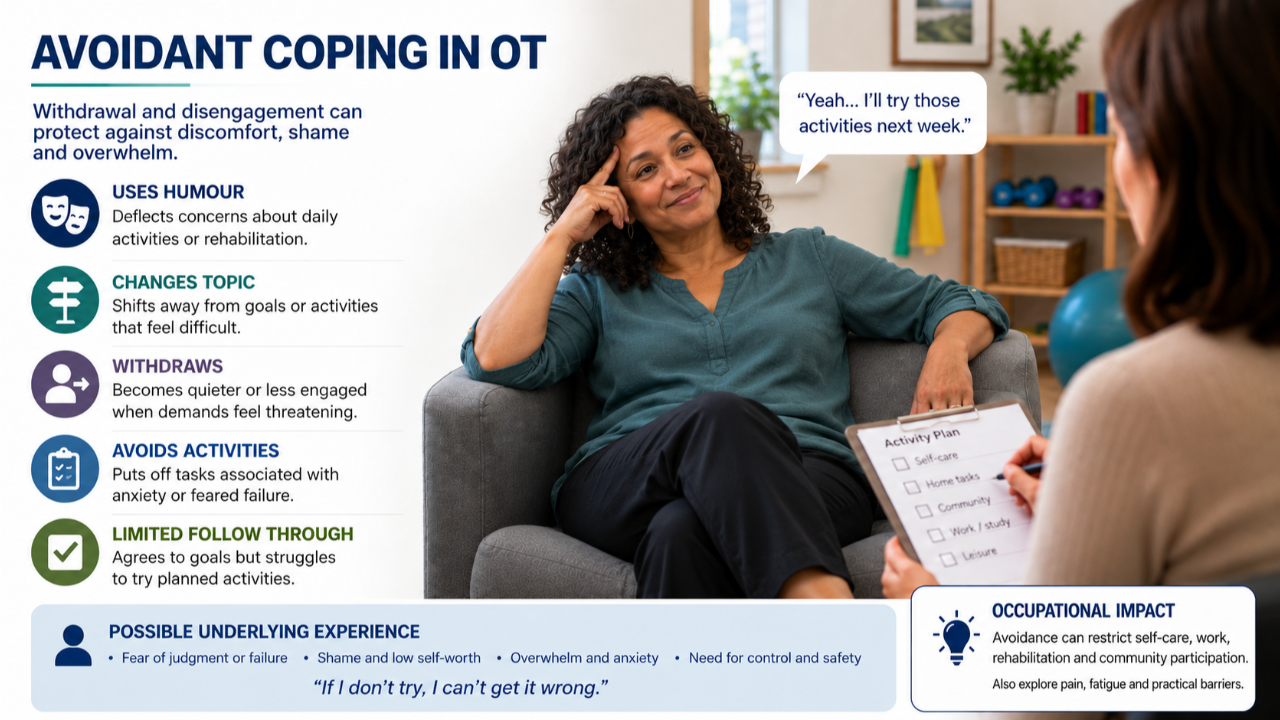
This 3-hour interactive training workshop supports occupational therapists to work more effectively with clients who appear disengaged, withdrawn, ambivalent or unmotivated. It introduces a psychologically informed framework for understanding avoidance as a possible threat-based protective response and exploring how it affects therapeutic engagement and occupational participation.
Participants will explore how perceived safety, emotional regulation and relational dynamics can influence motivation and engagement. Practical examples connect these concepts to self-care, rehabilitation activities, home programmes, return to work and community participation. Participants will also consider pain, fatigue, cognitive difficulties and environmental barriers when exploring reduced participation.
The focus is practical, ethical and clinically grounded: recognising early signs of withdrawal, preventing relational ruptures and restoring engagement without pressure or confrontation. Strategies support collaborative choices about goals, activities and manageable next steps within occupational therapy practice.
What will this course give you?
• A clearer understanding of how avoidant coping can affect everyday activities and participation
• Practical ways to reduce defensiveness and increase psychological safety during OT interventions
• Greater confidence responding to missed appointments, ambivalence, humour or shutdown
• Skills to repair subtle relational ruptures before engagement is lost
• Ways to explore avoidance of agreed activities and home programmes
without assuming a lack of motivation
• Tools to support autonomy, motivation and progress towards meaningful occupational goals
Teaching Methods
This training is delivered live online and uses a mix of brief expert instruction, facilitated discussion, live demonstration and supported practice. Participants engage in guided reflection, OT-focused clinical vignette work and practical exercises, with debriefs to consolidate learning.
Vignettes and role plays explore avoidance of agreed activities, perceived threat or feared failure, and the impact on daily routines and occupational participation. Participants practise curiosity, validation, micro-repair and collaborative communication to support a manageable next step.
Downloadable worksheets and participant reference materials are provided to support integration into occupational therapy practice.
Assessment / Evidence of Learning
Learning is evidenced through active participation in guided reflection, clinical discussion and practical exercises during this live workshop. Supported skills practice and debriefing provide opportunities to demonstrate and reflect on the learning objectives.
Participants receive a certificate of attendance for 3 CPD hours.
Learning Objectives
By the end of the workshop, participants will be able to:
1. Evaluate avoidance and disengagement as possible threat-based protective responses within occupational therapy practice, while considering other barriers to participation.
2. Identify and assess observable indicators of withdrawal, ambivalence and reduced engagement in therapeutic activities and occupational participation.
3. Demonstrate strategies that increase psychological safety, protect autonomy and reduce defensiveness during occupational therapy interventions.
4. Apply and evaluate techniques for responding to ambivalence and repairing relational ruptures to support sustained engagement and progress towards occupational goals.
About the Presenter
Karen Bartle is a postgraduate in Health Psychology, Advanced Clinical Hypnotherapist and coach, clinical supervisor, educator, and consultant. She co-founded the Academy of Advanced Changework in 2006, and is the founder of HealthTalk Psychology - 'The psychology of patient/client change'.
For over 25 years, Karen has worked with individuals, caregivers, and health professionals navigating behavioural, lifestyle, and psychosocial challenges. She has seen first-hand how caring practitioners can feel stuck when empathy, education, coaching and even motivational interviewing can’t shift engagement — and how reframing avoidance can transform therapeutic outcomes.
Karen’s teaching style blends clinical depth with clarity and compassion. She is known for translating complex psychological concepts into language practitioners can use immediately, and for creating learning environments that feel safe, reflective, and practical.
Who is this course for?
This training is designed for occupational therapists who work with clients who withdraw, shut down, disengage or struggle to follow through with agreed activities or interventions.
It is relevant across mental health, rehabilitation, persistent pain, vocational and community practice, wherever avoidance or ambivalence affects self-care, daily routines, work or social participation.
The workshop supports psychologically informed OT practice, with strategies applied within each practitioner’s role and scope.
Places are limited to ensure an interactive, skills-focused learning experience.
Course Feedback
"I've really enjoyed your training, and how you present the topics. Very Professional, calm and insightful."
"I really enjoyed the workshop and have two coworkers attending your next one!"
"The training was rich in content and strategies, was also interactive which is always good. I enjoyed it and found it beneficial."
"Thankyou for such an amazing webinar. It was extremely helpful and informative."
“Thanks so much for the workshop. I really enjoyed it. I got a lot of great tips and skills to use”
"An interesting presenter and gentle presentation and that in itself taught me something about her values and how to be with clients. I was reminded of the care that is needed to assist vulnerable clients hoping for some changes."
“I really enjoyed learning more about this topic of creating a safe space for clients. It allowed me to reflect upon the clients I have worked with as a therapist, also as a client myself - working with therapists who were not safe, and who also broke rapport with me.”
"Thankyou, Karen. This session was excellent!"
“The quality of content, course organisation, course documents, and ability to sustain my interest were all great.”
“An interesting and thought-provoking session”
“The course developed my skills…and the quality of communications and explanation of what was expected were very good”
"Thank you for your authentic presentation, affirming discussions and inclusive time with this group. Beautiful values and ideas presented today and modelling of what a safe and genuinely person-centred therapist is like."
“Clients can feel gaslit that it was somehow their ‘fault’ things didn’t work with their therapist. Clients come to therapists for help, and the gravity of this shone through with this cpd.”
"I genuinely enjoyed the speaker and appreciated the material, thank you."
"Practical, relatable and immediately applicable. This training has transformed the way I work with clients who seem 'checked out'."
“Tutor approachability was very good and I felt valued during the workshop”
“I enjoyed learning about and reflecting on all the reasons why clients are ‘resistant’ (which I see now can be a brilliant subconscious protection mechanism) …and how I cannot control all of these reasons, but I can remember the importance of creating a safe therapy space.“
"I learned the importance of your own regulation and the ability to sit in the stillness and silence."
"I feel I know how to recognise this now and that I .have so many things I can say (or not say!?)"
"I learned the importance of helping them stay safe."
"I feel I know how to recognise this now and that I have so many things I can say (or not say!?)"
"I learned to remember to reaffirm autonomy"
"I recognise that silence is not always a bad thing"
"I'll remember to not to worry if we go slow & the client stops talking."
"Love the idea of lowering urgency in a session to rebuild trust."
"Not to be in a rush to ease their discomfort but always make them feel safe"
"Use some non-threatening phrases rather than questions to move the session along"

Debbie Hill
Paul and Karen operate their business with sincerity and integrity. They are professional, warm, embracing, fun and brave individuals with a wealth of shared training, education and therapeutic experience.

Kirstie Nicholson
I can't speak highly enough of both Karen and Paul. They're very experienced, knowledgeable and SO supportive.

Clare Longstaffe
Karen and Paul have a down to earth, friendly approach and are experts in their field. Their work is infused with professional integrity and I can thoroughly recommend their courses to those interested in this path.
